einops, built into a language.
ShapeScript is a typed tensor language. Axis names and sizes are part of the syntax. Every shape is checked before any code runs. It compiles to Python that calls PyTorch, so you keep using the same libraries.
pip install --pre shapescript## Model width.
dim D = 768
## Number of attention heads.
dim H = 12
## Width of each head. The checker verifies that D is divisible by H.
dim Dh = D / H
fn causal_attention(x: [b n D], w_qkv: [D 3*D], w_o: [D D]) -> [b n D]:
q, k, v = x @ w_qkv‹b n 3*D›
|> split(b n (3 H Dh) -> b H n Dh)‹b H n Dh› ×3
att = einsum(q, k: b H n Dh, b H m Dh -> b H n m)‹b H n m›
|> scale(1 / sqrt(Dh))‹b H n m›
|> masked_fill(!causal[n m], -inf)‹b H n m›
|> softmax(over=m)‹b H n m› Prob over m
return einsum(att, v: b H n m, b H m Dh -> b H n Dh)‹b H n Dh›
|> rearrange(b H n Dh -> b n (H Dh))‹b n (H Dh)›
|> matmul(w_o)‹b n D›Causal attention. It compiles. The grey shapes at the line ends are what the checker infers, as the editor shows them. Each example below is code like this with one bug.
Six bugs PyTorch lets through
Each example is PyTorch code with a bug, and what happened when it ran. Under it is the same code in ShapeScript, with the error the checker reports.
def attention(x, w_qkv, w_o):
q, k, v = (x @ w_qkv).view(b, n, 3, H, Dh).permute(2, 0, 3, 1, 4)
att = torch.einsum("bhnd,bhmd->bhnm", q, k) / math.sqrt(Dh)
att = att.masked_fill(~causal, float("-inf")).softmax(dim=-1)
y = torch.einsum("bhmn,bhmd->bhnd", att, v)
return y.transpose(1, 2).reshape(b, n, D) @ w_oWhen runRuns. The output is [2, 16, 768] with no NaNs, and every token attends to the wrong positions: n and m are both the sequence length, so nothing can tell them apart.
## Model width.
dim D = 768
## Number of attention heads.
dim H = 12
## Width of each head. The checker verifies that D is divisible by H.
dim Dh = D / H
fn causal_attention(x: [b n D], w_qkv: [D 3*D], w_o: [D D]) -> [b n D]:
q, k, v = x @ w_qkv‹b n 3*D›
|> split(b n (3 H Dh) -> b H n Dh)‹b H n Dh› ×3
att = einsum(q, k: b H n Dh, b H m Dh -> b H n m)‹b H n m›
|> scale(1 / sqrt(Dh))‹b H n m›
|> masked_fill(!causal[n m], -inf)‹b H n m›
|> softmax(over=m)‹b H n m› Prob over m
return einsum(att, v: b H m n, b H m Dh -> b H n Dh)error E0408 the pattern calls axis 3 m, but m is axis 4 of [b H n m] Prob over maxis 3 is npatterns name axes by positionto reorder the axes, use rearrange first |> rearrange(b H n Dh -> b n (H Dh))
|> matmul(w_o)def loss(x, w, y):
p = (x @ w).softmax(dim=-1)
return F.cross_entropy(p, y)When runRuns and returns a loss (6.91). cross_entropy applies its own softmax, so this one trains, just worse, and nothing says why.
dim D = 768
dim C = 1000
fn loss(x: [b D], w: [D C], y: [b] Index[C]) -> [] NonNeg:
p = x @ w |> softmax(over=C)‹b C› Prob over C
return cross_entropy(p, y, over=C)error E0501 expected Logit over C, got Prob over Cthis is [b C] Prob over Csoftmax applied before cross_entropy?def embed(emb, ids):
return emb[ids]
embed(token_table, labels) # labels are class ids in [0, 1000)When runRuns. Every class id is a valid row of the 32,000-row token table, so the lookup succeeds and returns the wrong embeddings.
dim V = 32000
dim D = 768
dim C = 1000
fn embed(emb: [V D], ids: [b t] Index[C]) -> [b t D]:
return emb[ids]error E0507 expected Index[V], got Index[C]this is [b t] Index[C]the sizes differ: C = 1000, not V = 32000def pool(x): # x: (b, n, D)
return x.mean(dim=-1)When runRuns and returns (b, n) instead of (b, D). Nothing complains until a later layer does, and never if n happens to equal D.
dim D = 768
fn pool(x: [b n D]) -> [b D]:
return x |> reduce(b n D -> b n, mean)‹b n›error E0401 mismatched shape: expected [b D], found [b n]the return type is [b D]axis 2: n is not known to equal D = 768def forward(img, embed, head):
x = img.unfold(2, 16, 16).unfold(3, 16, 16)
x = x.permute(0, 2, 3, 4, 5, 1).reshape(img.shape[0], -1, 16 * 16 * 3)
return (x @ embed).mean(dim=1) @ headFails at runtimeRuntimeError: mm: mat1 and mat2 shapes cannot be multiplied (8x768 and 512x192)
dim D = 192
dim C = 10
dim Images = [b 3 16gh 16gw]
model Classifier:
param embed: [512 D] = normal(std=0.02)
param head: [D C] = normal(std=0.02)
fn forward(m: Classifier, img: Images) -> [b C]:
return img‹b 3 (gh 16) (gw 16)›
|> rearrange(b c (gh p1) (gw p2) -> b (gh gw) (p1 p2 c))‹b (gh gw) (p1 p2 c)›
|> matmul(m.embed)error E0401 can't multiply [b (gh gw) (p1 p2 c)] by [512 D]this is [512 D]the axes @ contracts differ: (p1 p2 c) = 16*16*3 = 768, not 512 |> reduce(b t D -> b D, mean)
|> matmul(m.head)def log_gate(x, w):
g = torch.sigmoid(x @ w)
return torch.log(g)When runRuns, and returns -inf wherever sigmoid rounds to 0 (774 of 2,000 values in our test), which turns into NaN gradients later.
dim D = 768
dim C = 1000
fn log_gate(x: [b D], w: [D C]) -> [b C]:
g = x @ w |> sigmoid‹b C› Unit
return log(g)warning W0501 g can be exactly 0log(0) is -infit's Unit, so its values are in [0, 1]use log_sigmoid(x @ w)It compiles to Python
shapescript build writes ordinary Python that calls PyTorch. You can read it, import it from Python and use it in a notebook.
## Model width.
dim D  = 768
## Number of attention heads.
dim H  = 12
## Width of each head. The checker verifies that D is divisible by H.
dim Dh = D / H

fn causal_attention(x: [b n D], w_qkv: [D 3*D], w_o: [D D]) -> [b n D]:
    q, k, v = x @ w_qkv‹b n 3*D›
        |> split(b n (3 H Dh) -> b H n Dh)‹b H n Dh› ×3

    att = einsum(q, k: b H n Dh, b H m Dh -> b H n m)‹b H n m›
        |> scale(1 / sqrt(Dh))‹b H n m›
        |> masked_fill(!causal[n m], -inf)‹b H n m›
        |> softmax(over=m)‹b H n m› Prob over m

    return einsum(att, v: b H n m, b H m Dh -> b H n Dh)‹b H n Dh›
        |> rearrange(b H n Dh -> b n (H Dh))‹b n (H Dh)›
|> matmul(w_o)‹b n D›def causal_attention(x, w_qkv, w_o, _ss_pad=None):
_ss_dev = _ss_rt.device()
_ss_d_n = x.shape[1]
_ss_pads = _ss_rt.pads(_ss_pad, {"n": 4})
_ss_t1 = x @ w_qkv
q, k, v = _ss_einops.rearrange(_ss_t1, "b n (i0 H Dh) -> i0 b H n Dh", i0=3, H=H, Dh=Dh).unbind(0)
_ss_t2 = _ss_torch.einsum("bHnD,bHmD->bHnm", q, k)
_ss_t3 = _ss_t2 * (1 / _ss_torch.sqrt(_ss_rt.to_float(Dh)))
_ss_t4 = _ss_t3.masked_fill(_ss_torch.logical_not(_ss_rt.causal(_ss_d_n, _ss_d_n, _ss_dev)), -_ss_math.inf)
att = _ss_rt.masked_along("softmax", _ss_t4, 3, _ss_pads, ((4, 3),))
_ss_t5 = _ss_torch.einsum("bHnm,bHmD->bHnD", _ss_rt.fill(att, _ss_pads, ((4, 3),)), v)
_ss_t6 = _ss_einops.rearrange(_ss_t5, "b H n Dh -> b n (H Dh)")
return _ss_t6 @ w_oshapescript build attention.ss --checks=off, the function only. Patterns become einops and einsum strings, D / H is worked out to 64, and _ss_rt is ShapeScript's small runtime.
dim D = 768

fn mlp(x: [b n D], w1: [D 4*D], w2: [4*D D]) -> [b n D]:
    return x @ w1 |> gelu |> matmul(w2)‹b n D›
def mlp(x, w1, w2):
    _ss_dev = _ss_rt.device()
    return _ss_F.gelu(x @ w1) @ w2
shapescript build mlp.ss --checks=off, the function only. With checks on (the default), it also checks each argument's rank, dtype, device and sizes on entry.
Python and ShapeScript call each other
Each language calls the other directly, and one debugger steps through both. Your datasets, libraries and notebooks stay as they are.
import shapescript
shapescript.install()                    # lets `import` find .ss files
shapescript.devices("cuda[0]")           # once per program, unless a .ss module declares `devices`

from model import causal_attention       # compiles model.ss (cached)
y = causal_attention(x, w_qkv, w_o) # argument shapes are checked on entryimport python torch
dim D = 768
fn load_qkv() -> [D 3*D]:
return torch.load("w_qkv.pt") as [D 3*D]
## The complementary error function, $1 - \operatorname{erf}(x)$.
extern fn erfc(x: Real) -> NonNeg = "torch.special.erfc"
Training without the footguns
You can still train from Python: a ShapeScript model is a torch.nn.Module, so your loop, Lightning or anything else works with it. But training in ShapeScript is better.
This is a whole training program, on three GPUs. Here are the mistakes PyTorch and Lightning allow that it can't make. Point at one to see the lines that rule it out.
Every tensor is made on the device the program declares. No code mentions a device.
devices cuda[0 1 2]

dim D  = 784
dim Hd = 256
dim C  = 10

model Mlp:
    param w1: [D Hd] = normal(std=0.02)
    param w2: [Hd C] = normal(std=0.02)

data Digit:
    img:   [D]
    label: [] Index[C]

logs StepLogs:
    loss:      [] mean
    grad_norm: [] max

fn forward(m: Mlp, x: [b D], mode: Mode) -> [b C] Logit over C:
    return x @ m.w1 |> gelu |> dropout(0.1, mode) |> matmul(m.w2)‹b C›

fn loss(m: Mlp, batch: [b] Digit, mode: Mode) -> [] NonNeg:
    return cross_entropy(forward(m, batch.img, mode), batch.label, over=C)

fn train_step(mut m: Mlp, mut opt: AdamW[Mlp], batch: [b] Digit, mode: Mode) -> StepLogs:
    l, g = value_and_grad(loss, m, batch, mode)
    n = norm(g)
    update(mut m, mut opt, g |> clip_norm(1.0))
    return StepLogs(loss=l, grad_norm=n)

fn fit(mut m: Mlp, train: Dataset[Digit], sink: LogSink, epochs: int, mode: Mode):
    opt = adamw(m, lr=3e-4)
    run(mut m, mut opt, train, sink, 0, epochs, mode)

fn run(mut m: Mlp, mut opt: AdamW[Mlp], train: Dataset[Digit], sink: LogSink,
       first: int, epochs: int, mode: Mode):
    for epoch in first..epochs:
        for batch in train |> shuffle(seed=epoch) |> batches(64):
            sink.write(train_step(mut m, mut opt, batch, mode))
        sink.flush()
        save("ckpt.pt", m, opt, epoch + 1)
        print("epoch", epoch, "done")
The VS Code extension
The extension has the language server inside it. It shows the shape of every value as you write.


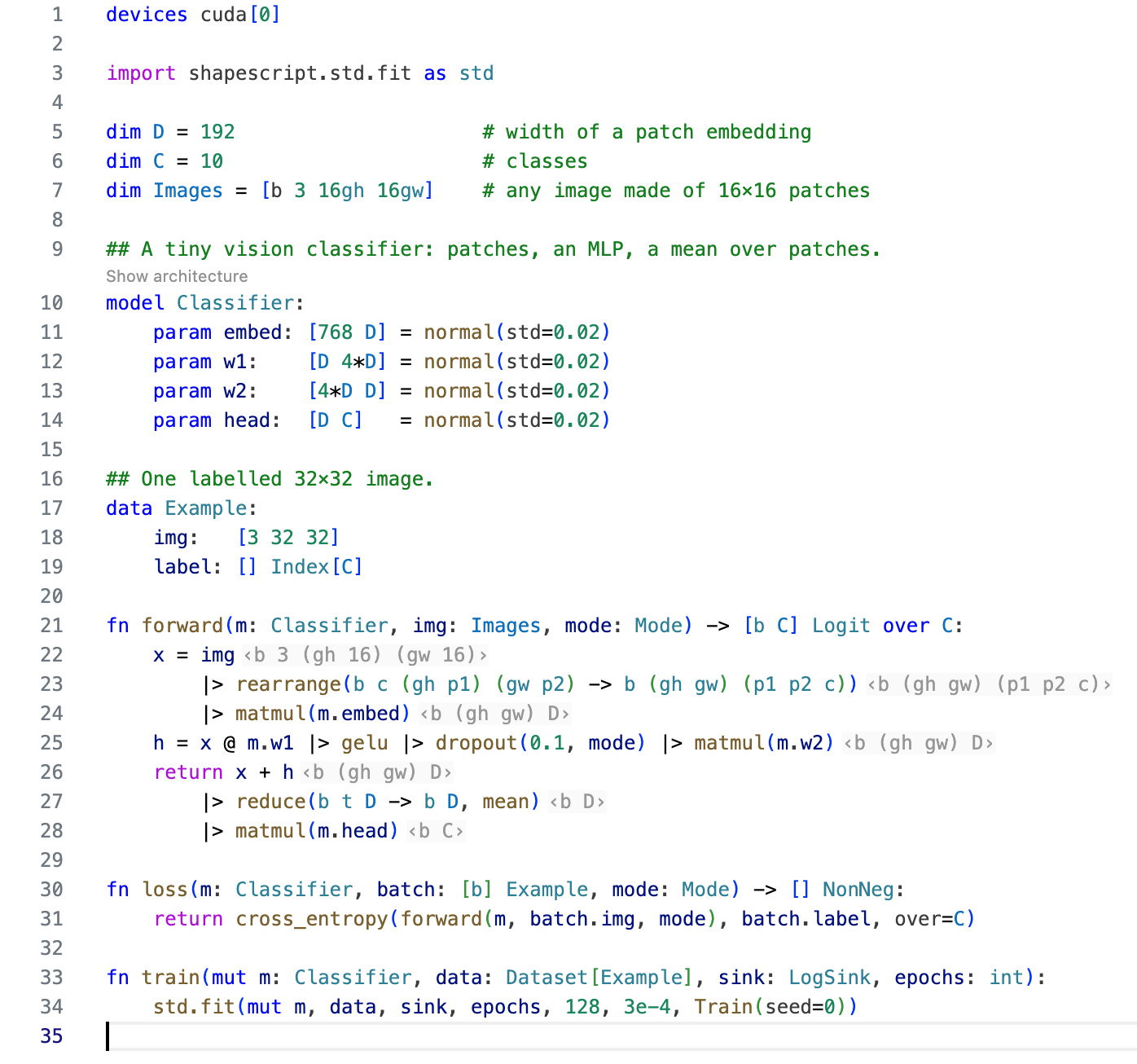
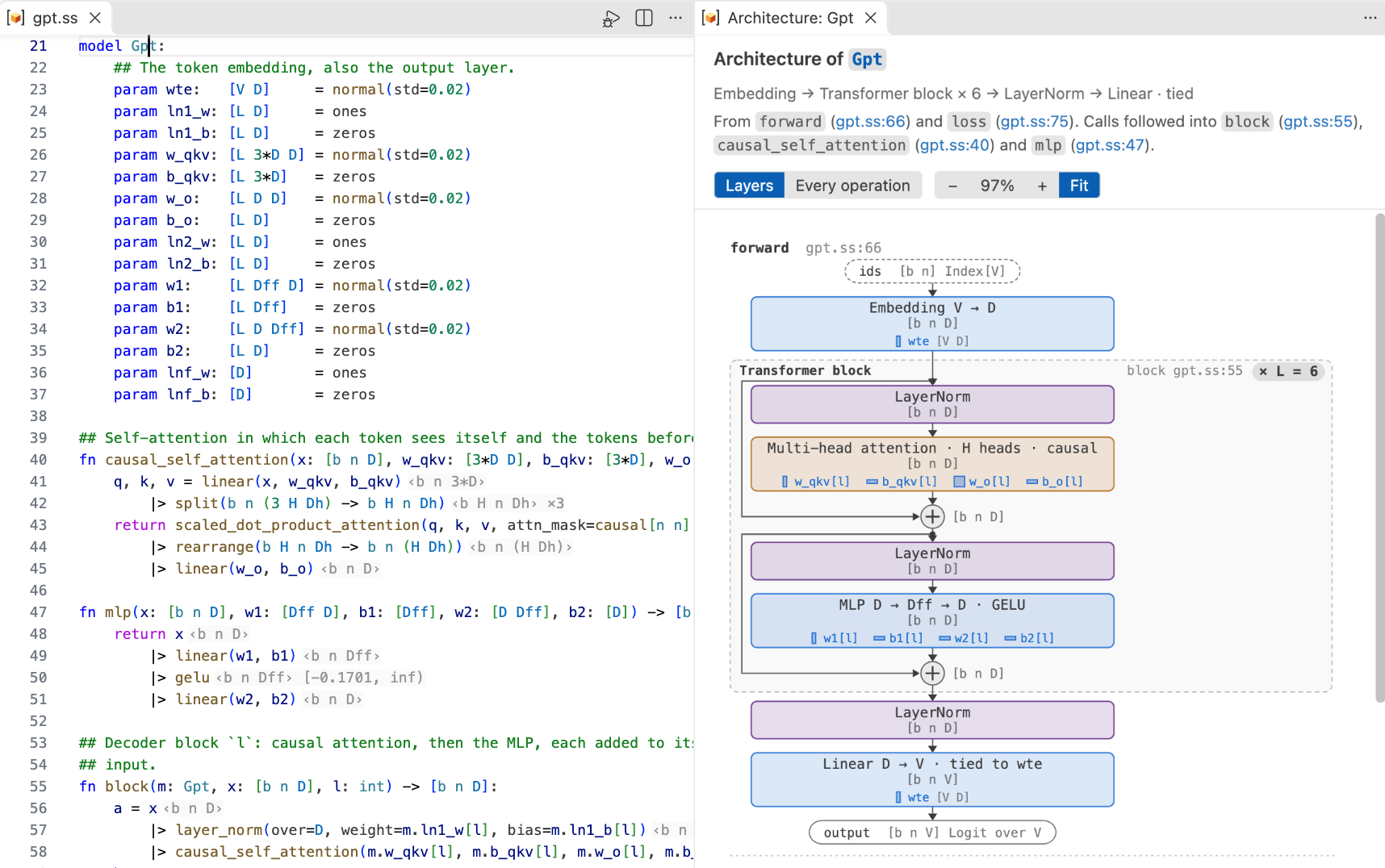
Running and exporting
The same program exports for torch.export and Hugging Face, runs in notebooks, and runs on one GPU or several.
dim D = 768

export fn patchify(img: [b 3 16gh 16gw]) -> [b (gh gw) D]:
return img |> rearrange(b c (gh p1) (gw p2) -> b (gh gw) (p1 p2 c))‹b (gh gw) (p1 p2 c)›import torch
patchify = torch.export.load("patchify.pt2").module() # no ShapeScript needed
tokens = patchify(torch.randn(4, 3, 224, 160)) # [4 140 768]For vLLM, the checker proves the model has the form a serving engine needs, and says which rule it breaks if it doesn't:
- It takes token ids,
[b n] Index[V], and optionally positions, and gives next-token logits,[b n V]. - It starts with an
embeddingand ends with alinearoutput layer, which the engine runs itself. - Only causal
scaled_dot_product_attentionworks across positions, so the engine can swap in its own attention and cache.
The engine runs the embedding, attention and output layer, and the rest is your source, compiled.
%%shapescript
devices cpu
dim D = 768
fn mlp(x: [b D], w1: [D 4*D], w2: [4*D D]) -> [b D] = x @ w1 |> gelu |> matmul(w2)‹b D›Install the beta
The current release, 0.1.2b1, is a pre-release, so pip needs --pre.
Python package
The compiler, the language server, the runtime and the notebook magic.
pip install --pre shapescriptVS Code extension
Hovers, inlay hints and the Architecture tab. The language server is inside it.
code --install-extension shapescript.shapescriptDocumentation
The book and the language reference are in the repository.